July - 24 - 2026
Parents today spend a lot of time researching what children should learn before school. Early literacy, communication skills, emotional confidence, and independence often top the list.
But what if one of the most powerful learning environments isn't a classroom at all?
According to the World Health Organization, children under five should engage in at least 180 minutes of physical activity every day, including energetic play. Yet studies continue to show that many young children spend significantly less time outdoors than previous generations, particularly in urban environments.
Many nurseries address outdoor time with a small play area and a slide.
At Vision Nursery, outdoor learning is designed differently.
From a dedicated bike trail and serenity garden to age-separated outdoor zones and nature-based play spaces, every outdoor feature serves a developmental purpose. These environments are carefully planned to support physical, emotional, social, and cognitive growth in line with EYFS principles.
In this article, we'll explore what these outdoor spaces are really teaching your child and why outdoor play is a curriculum decision, not simply a break between lessons.
Outdoor play is often viewed as recreation. Science suggests it's much more than that.
Research published by the American Academy of Pediatrics found that unstructured play, particularly outdoor play, supports executive function, emotional regulation, creativity, and social problem-solving more effectively than highly structured academic activities during the preschool years.
In simple terms, outdoor environments help children develop the mental skills they need for future learning.
The prefrontal cortex is responsible for decision-making, self-control, planning, and problem-solving.
When children climb, balance, navigate obstacles, negotiate turns, or assess manageable risks, this part of the brain becomes highly active.
A child deciding whether they can cross a balance beam or ride around a corner is not just playing. They are making judgments, evaluating outcomes, and strengthening neural pathways that support lifelong learning.
These experiences help build:
These are the same skills children rely on when transitioning into formal schooling.
Nature offers benefits that manufactured environments simply cannot replicate.
Studies have shown that exposure to natural environments can reduce cortisol levels, the body's primary stress hormone, even among young children.
For preschool-aged children, regular interaction with greenery, plants, soil, and natural textures has been linked to:
In a city environment, access to purposeful green spaces becomes even more valuable.
If a 20-minute session in a garden can measurably lower a child's stress levels, what does a daily routine of outdoor learning actually do?
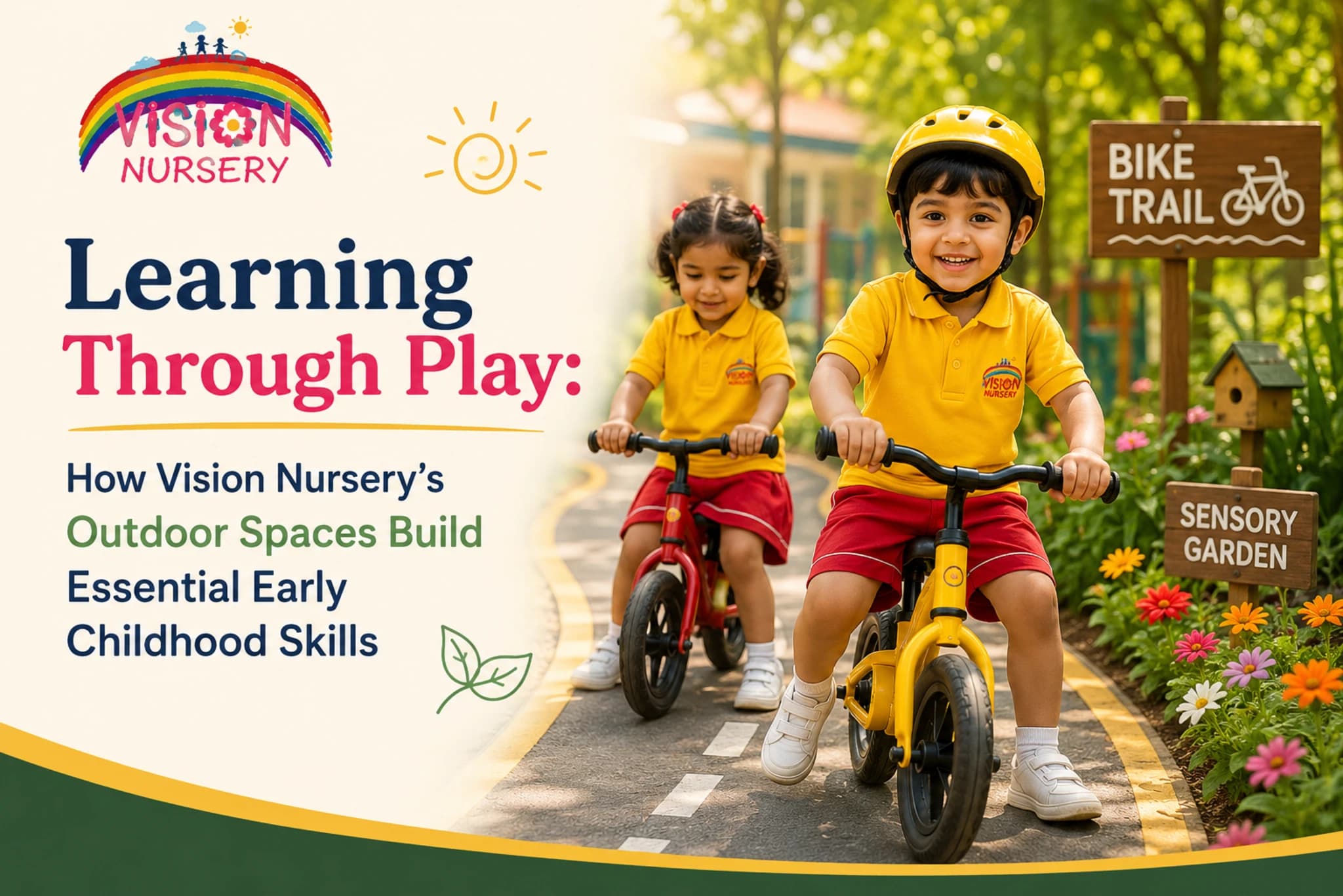
At first glance, the bike trail looks like a place where children have fun.
In reality, it is one of the most powerful developmental tools on campus.
Cycling at preschool age is not simply physical exercise. It is a neurological workout.
Balancing, steering, pedalling, stopping, observing surroundings, and responding to obstacles all require multiple areas of the brain to work together simultaneously.
When children ride a bike, they coordinate movement across both sides of their body.
This process, known as bilateral coordination, strengthens communication between the brain's hemispheres and supports future learning skills.
Strong bilateral coordination contributes to:
These foundational skills influence everything from classroom participation to pencil control.
Research consistently shows that children benefit from manageable levels of challenge during play.
When children navigate turns, adjust speed, or learn to balance independently, they develop confidence in their ability to overcome obstacles.
The tree-lined bike trail at Vision Nursery introduces natural sensory cues that encourage concentration, environmental awareness, and focused attention.
Children learn:
These lessons often matter more than the physical skill itself.
Every parent remembers the moment a child achieves a new physical skill independently.
Whether it's climbing stairs, jumping with both feet, or riding a bike, mastery creates a powerful sense of achievement.
These moments build resilience and foster a growth mindset.
Children begin to understand that progress comes through practice, persistence, and effort, an important lesson long before formal academics begin.
Many parents are surprised to learn that gardening supports academic development
Research published in the Journal of Environmental Psychology found that children who regularly participated in gardening activities demonstrated improved attention spans and stronger scientific understanding compared to peers with limited exposure to nature-based learning.
At Vision Nursery, the Serenity Garden is much more than a beautiful outdoor feature. It is a living classroom.
Gardening naturally introduces children to early scientific thinking. Children learn that actions produce outcomes.
Planting seeds, watering plants, observing growth, and tracking changes over time teaches:
These experiences support later understanding in mathematics, science, and literacy.
The process becomes:
This simple sequence lays the foundation for logical thinking.
Nature provides rich sensory experiences that support nervous system development.
Children interact with:
These sensory experiences help children feel grounded and calm. Mindfulness in early childhood isn't about sitting quietly. It's about meaningful engagement with the world around them. The Serenity Garden creates opportunities for exactly that.
Children who participate in growing food often develop stronger connections with healthy eating.
When a child watches something grow from seed to harvest, curiosity naturally increases. Vegetables become less intimidating and more familiar.
These early experiences can positively influence food choices and attitudes toward nutrition for years to come.
Many nurseries operate with one shared outdoor space for all age groups.
Vision Nursery takes a different approach. Outdoor areas are intentionally separated according to developmental stages.
This design supports safety, but its greatest benefit is developmental.
A two-year-old and a five-year-old experience the world very differently.
Their physical capabilities, confidence levels, communication skills, and risk tolerance vary significantly. When younger children share play spaces with much older children, they may become hesitant or withdrawn. Instead of exploring confidently, they may spend more time observing from the sidelines.
Educational psychologist Lev Vygotsky introduced the concept known as the Zone of Proximal Development.
Children learn best when activities challenge them slightly beyond their current abilities, not so easy that they become bored and not so difficult that they become overwhelmed.
Age-separated outdoor environments help create this balance.
At Vision Nursery, thoughtfully designed spaces, colourful murals, and soft impact-absorbing surfaces encourage exploration while helping children feel safe and secure.
The result is greater independence, confidence, and willingness to engage.
Outdoor play is not a break from learning. It is learning.
Every turn on the bike trail, every seed planted in the garden, and every moment spent exploring an age-appropriate outdoor space contributes to a child's physical, emotional, social, and cognitive development.
At Vision Nursery, outdoor environments are intentionally designed to support EYFS outcomes, ensuring that play experiences translate into meaningful developmental growth.
For parents searching for a nursery with outdoor play areas in Abu Dhabi, the question is no longer whether outdoor learning matters.
The question is whether the environment has been designed with purpose.
Because some of the most important lessons your child will ever learn happen outside.
Visit our Al Falah or MBZ City campus and see all Vision Nursery facilities for yourself.
Book a visit today:
WhatsApp:
+971 55 445 5872
Finding the Best Preschool in Al Falah, Abu Dhabi: A Parent's Complete Guide to Choosing an EYFS Nursery
Aug - 19 - 2026
Is Your Child Ready for School? How Vision Nursery's EYFS Programme Prepares Kids in Al Falah for KG1
July - 03 - 2026
7 Questions Smart Abu Dhabi Parents Ask Before Choosing a Nursery
June - 18 - 2026
Not All Nurseries Feel the Same: Choosing a Villa Based EYFS in Abu Dhabi
June - 4 - 2026
The Hidden Reason Children Settle Faster In Villa-Based Nurseries
May - 20 - 2026
What Are the 7 Areas of Learning in EYFS
May - 14 - 2026Vision Nursery © COPYRIGHT 2024. All Rights Reserved
Designed By CODE PUBLICIST